The National Adaptation Plan Process: Frequently asked questions
The impacts of climate change are happening today and will continue to be felt over this century and beyond. Responding effectively to climate change requires urgently cutting our emissions as well as adapting to its impacts. The national adaptation plan (NAP) process is an important way that countries can build their resilience to these impacts.
Au Secrétariat du Réseau mondial PNA, on nous demande souvent – par un éventail d'acteurs – d'expliquer ce qu'est le processus PNA et pourquoi il est important. Vous trouverez ci-dessous quelques-unes des questions courantes que nous entendons.
Vous avez d'autres questions sur le processus PNA auxquelles vous aimeriez que nous répondions ? Veuillez nous contacter à : info@napglobalnetwork.org
LES BASES
The official definition, objectives, and guidelines of the NAP process are available via the United Nations Framework Convention on Climate Change (UNFCCC) site.
En termes simples, le processus PNA est un processus stratégique qui permet aux pays d'identifier et de répondre à leurs priorités à moyen et long terme pour s'adapter au changement climatique.
Dirigé par les gouvernements nationaux, le processus PNA consiste à analyser le changement climatique actuel et futur et à évaluer la vulnérabilité à ses impacts. Cela fournit une base pour identifier et hiérarchiser les options d'adaptation, mettre en œuvre ces options et suivre les progrès et les résultats.
En fin de compte, le processus PNA vise à rendre les personnes, les lieux, les écosystèmes et les économies plus résilients aux impacts du changement climatique.
The NAP process also strives to make adaptation part of standard development practice, where adaptation needs are embedded in how countries plan their futures, invest their resources, and track their progress. (See the official UNFCCC wording of the NAP process’s two objectives ici.)
Il est important de noter que le processus PNA met en place les systèmes et les capacités needed to make adaptation an integral part of a country’s development planning, decision making, and budgeting while ensuring it is ongoing practice rather than a separate ad hoc exercise.
Within the context of UNFCCC discussions, NAP stands for “national adaptation plan” while the broader governance process for adaptation is referred to as the “NAP process.”
This reflects that there is both a document (plan) and a process (planning). The term national adaptation planning is also often used to describe the process itself (in the place of NAP process).
In regular conversation and practice with relevant actors, it does not matter which term is used; what is important is that everybody has a shared understanding that it is a process for identifying and addressing a country’s priorities for adapting to climate change.
HISTORIQUE DES PNA ET DU PROCESSUS PNA
Le processus PNA a été officiellement établi en 2010 sous la Cadre d'adaptation de Cancún, which was an outcome of the 16th Conference of the Parties to the UNFCCC. It was established to help countries embed adaptation in core development decision making; this ensures adaptation is not treated as a separate environmental issue.
The NAP process was also put in place to make sure countries look at adaptation over the medium and longer terms—a shift from ad hoc, project-based adaptation interventions focused on short-term needs toward more strategic and programmatic approaches.
Many countries were also making efforts to identify adaptation needs and integrate them into their decision-making processes prior to 2010 (see below). The NAP process builds on this work and seeks to scale up adaptation.
Absolutely. The NAP process isn’t the first attempt under the UNFCCC to facilitate adaptation planning in developing countries. In 2001, least developed countries (LDCs) were invited to develop programmes d'action nationaux d'adaptation (PANA), qui visait à identifier les besoins d'adaptation urgents et immédiats. Plus de 50 PMA ont répondu à cet appel en soumettant une liste de projets d'adaptation prioritaires dans divers secteurs (CCNUCC, 2017).
La principale différence entre les PANA et les PNA est que, bien que les PANA se concentrent sur assistance technique à court terme besoins et priorités d'adaptation, le processus PNA cherche à identifier et à moyen et long terme besoins d'adaptation. Cela dit, les processus PNA dans les PMA devraient s'appuyer sur l'expérience de leurs PANA.
In addition to NAPAs, and outside of the formal UNFCCC process, many countries were already developing adaptation plans and/or integrating adaptation into development decision making prior to 2010. This included developing overarching national adaptation strategies, sector-based plans, and plans at sub-national levels. The NAP process is an opportunity to pull these efforts together into a cohesive whole and build on them in a coordinated approach.
2010: NAP PROCESS ESTABLISHED
The NAP process is formally established at the 16th Conference of the Parties to the UNFCCC under the Cadre d'adaptation de Cancún, qui a pour objectif de renforcer les actions d'adaptation dans les pays en développement.
2012 : ÉLABORATION D'ORIENTATIONS (ORIENTATIONS SUPPLÉMENTAIRES EN COURS)
Un ensemble de directives techniques is released by the Least Developed Countries Expert Group (LEG), the UNFCCC body tasked with providing support to LDCs in the NAP process.
S'appuyant sur les directives techniques de la CCNUCC, un certain nombre d'acteurs ont élaboré conseils supplémentaires for the NAP process on key issues, such as vertical integration, finance, gender, and monitoring, evaluation, and learning (MEL).
2014: NAP GLOBAL NETWORK ESTABLISHED
The NAP Global Network is established at the 14th Conference of the Parties to the UNFCCC in Lima, Peru, by a group of representatives from seven developing countries (Brazil, Jamaica, Malawi, Peru, Philippines, South Africa, and Togo) and four bilateral agencies (Germany, Japan, the United Kingdom, and the United States).
2015: PARIS AGREEMENT RECOGNIZES THE IMPORTANCE OF NAPS IN THE GLOBAL EFFORT TO ADDRESS CLIMATE CHANGE
At the 21st Conference of the Parties to the UNFCCC in Paris, France, 195 countries adopt the Paris Agreement, a global agreement to tackle climate change and its negative impacts. Article 7, paragraph 9 of the agreement states that “each party shall, as appropriate, engage in adaptation planning processes and the implementation of actions, including the development or enhancement of relevant plans, policies and/or contributions.” This is the only paragraph under the article on adaptation that obliges countries to take action, making the NAP process central to meeting the goals of the Paris Agreement.
At the same meeting, the Conference of the Parties requests the Green Climate Fund (GCF) to expedite support for the formulation of NAPs and subsequent implementation of policies, projects, and programs therein.
2016: GCF APPROVES FINANCIAL SUPPORT TO NAP PROCESSES
En réponse à la demande faite à Paris, qui reconnaissait que le soutien au processus PNA était souvent ponctuel, axé sur les projets et globalement insuffisant, le Conseil du FVC approuve le soutien financier pour la formulation des PNA. Les pays en développement peuvent accéder jusqu'à 3 millions de dollars chacun pour « la planification nationale de l'adaptation et d'autres processus de planification de l'adaptation » par le biais de son programme de préparation et de soutien préparatoire (Décision du Conseil d'administration du FVC B.13/09, paragraphe (e)).
2023: UAE FRAMEWORK FOR GLOBAL CLIMATE RESILIENCE (UAE FGCR) ADOPTED
At the 28th Conference of the Parties to the UNFCCC, the UAE FGCR was adopted as a framework to guide the achievement of the Global Goal on Adaptation that had been established under the Paris Agreement in 2015. The UAE FGCR decision acknowledges the importance of NAP processes and calls on countries to have NAPs and NAP processes by 2030.
2023: GCF EXTENDS FURTHER FINANCIAL SUPPORT FOR NAPS
The GCF Board approves a second USD 3 million window for NAP implementation at its 37th meeting.
2024: UPDATED GUIDANCE
The LEG releases an updated version of the 2012 technical guidelines on the NAP process, responding to developments in the UNFCCC process including the adoption of the Global Goal on Adaptation and the UAE FCGR.
TODAY: STEADY PROGRESS ON NAP PROCESSES, INCLUDING ITERATION
Overall progress in NAPs has been steady, although slower than desired—particularly among LDCs. The UNFCCC rapporté in November 2025 that 144 of the 154 developing countries have at least initiated a NAP process and are advancing them in different ways. Whether it is undertaking vulnerability assessments, establishing the institutional structures for adaptation decision making, identifying and prioritizing options, or securing resources to implement these options—countries are moving forward. As of October 2026, 121 countries have secured GCF funding for NAPs, and 81 developing countries have submitted their NAP documents to Centre NAP (although this does not reflect the full number of documents that have actually been produced by developing countries, as some have not yet been communicated to the UNFCCC).
The NAP process can drive progress toward achieving the Sustainable Development Goals (SDGs) and it can further sustainable development agendas.
Le Agenda pour le développement durable 2030, qui a établi les ODD, a renforcé la nécessité d'agir sur l'adaptation, à la fois en tant que un but en soi et comme moyen d'atteindre d'autres objectifs dans des domaines tels que la sécurité alimentaire et l'eau. Le processus PNA fournit un moyen d'opérationnaliser ces objectifs mondiaux.
Further, many countries align their NAP processes with other important sustainable development agreements with complementary aims and priorities, such as the Sendai Framework for Disaster Risk Reduction, the UN Convention on Biological Diversity, and the UN Convention to Combat Desertification. You can find analysis of alignment in NAP documents on our Plateforme Tendances NAP.
LE PROCESSUS PNA LUI-MÊME
The NAP process can be thought of as four broad phases—impact, vulnerability, and risk assessment (IVRA); planning; implementation; and MEL—which are aligned with the “iterative adaptation cycle” as defined under the UNFCCC. Achieving effective adaptation also requires a set of enabling factors throughout the NAP process—leadership; financing; technology; institutional arrangements; skills and capacities; data, knowledge, and communications; and engagement of the different actors involved.
During the IVRA phase, climate-related hazards, vulnerabilities, and risks are assessed, providing clarity to answer the question: What are we adapting to? Each country’s approach to national IVRAs is unique, with risk assessments conducted at different levels and scales (e.g., sectorally, regionally, by actor) and combining different sources of data and information and types of knowledge.
During the planning phase, countries set out a national vision for adaptation, identify and prioritize options for addressing these climate risks, and develop strategies for implementing these options. Many countries formulate a NAP document that is endorsed at a national level.
During the implementation phase, implementation strategies are fleshed out in greater detail, financing secured, and necessary technical and human resources procured and deployed. Progress, results, and lessons from implementation are tracked and reported through MEL.
Note: This figure is aligned with the NAP process modules presented in the updated 2024 directives techniques for the NAP process developed by the LEG with minor variations in framing. We encourage readers to consult the LEG technical guidelines for more details.
The national adaptation plan process and its enabling factors
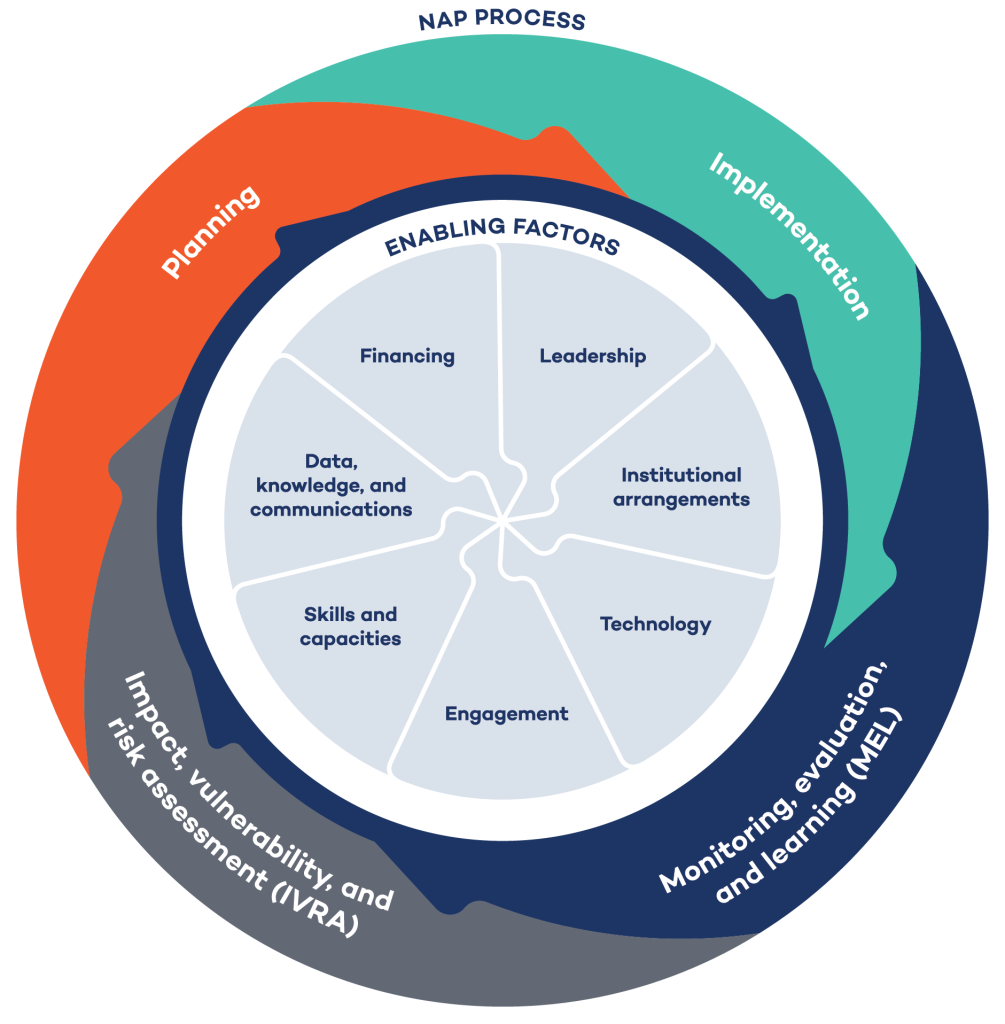
Yes. It is a bit confusing since the word “plan” of course appears in “NAP,” but as depicted in the figure above, the NAP process does involve more than just planning. Indeed, using the term “NAP process” is an attempt to emphasize that adaptation planning leads to something more—namely, implementation of action on the ground.
While robust planning—from assessing vulnerabilities and risks, to prioritizing adaptation needs, to identifying capacity gaps—is the foundation for meaningful adaptation action, it cannot stop there. All the resources that are invested into developing good plans, strategies, and policies must be translated into tangible efforts that reduce the vulnerability of people, ecosystems, and economies to the impacts of climate change; this is also why producing a NAP document cannot be seen as the most important result of a NAP process.
Both. But one of the most important things to emphasize is that national adaptation planning is an iterative process—it is a continuous cycle of climate risk assessment, planning, implementation, and MEL, adjusted over time based on feedback and lessons. That is, as countries improve their assessment of risks and discover what works and what does not work in their particular context, the NAP process should be improved.
Publishing a NAP document that presents the country’s approach and priorities for adaptation is often an important milestone in the NAP process. But some countries may choose not to develop a new NAP document if, for example, they already have a policy document that sets out their climate change adaptation priorities. Still others are developing multiple documents over the course of their NAP process, which may include sector adaptation plans and/or strategies.
Whatever a country’s approach to producing a NAP document, it is important to note that it is just one step of the broader process. In other words, the NAP process does not end with a document. Countries that have completed NAP documents continue to invest in their NAP processes by regularly assessing climate risks, engaging different actors inside and outside government, strengthening capacities, identifying sources of finance for implementation, tracking and reporting on their progress, and revisiting stated adaptation priorities.
Yes, but many actors—including those working at the sub-national and local levels—have an important role to play!
The word national in NAP would lead you to believe that the process is targeted solely at actors and institutions operating at the national level—e.g., central or federal governments, sector ministries, departments, etc. This is not strictly the case.
Successful NAP processes create intentional and strategic linkages between national and sub-national adaptation planning, implementation, and MEL—we often use the term “intégration verticale. »
Establishing and maintaining these national–sub-national linkages ensures that local priorities are reflected in the NAP process and that the national-level process enables adaptation at sub-national levels, including at the community level. And while priorities may be identified through a nationally driven process, implementing actions to address them will inevitably involve sub-national actors such as local authorities and civil society organizations. Without these actors, it will be difficult to achieve adaptation outcomes on a broad scale.
Enabling factors work as a set of interrelated conditions that can affect each phase of the NAP process. Like a puzzle, they often interact—for example, technology often supports data, knowledge, and communications.
The NAP Global Network emphasizes seven enabling factors. They incorporate concepts such as finance, technology, and capacity building, which are identified as means of implementation in UNFCCC decisions, and they look more comprehensively at the conditions that need to be in place for the NAP process to unfold effectively.
- Leadership: The active involvement of high-level political leaders and recognized “champions” who are committed to addressing adaptation.
- Arrangements institutionnels: Les règles, réglementations et structures organisationnelles associées qui permettent la coordination de l'adaptation entre les acteurs à tous les niveaux, ainsi que l'intégration systématique de l'adaptation dans les processus de développement.
- Engagement: Efforts that enable a range of diverse actors at all levels, including civil society organizations, the private sector, communities, the media, and academia, to influence decision making in the NAP process and participate in adaptation action.
- Données, connaissances et communications : The generation and use of (1) data and information, especially climate data; (2) knowledge, including local knowledge and research; and (3) key messages tailored to specific audiences to advance the NAP process.
- Compétences et capacités : Investissements dans les individus et les organisations à tous les niveaux pour s'assurer qu'ils disposent des compétences et des capacités nécessaires pour permettre des processus PNA efficaces et efficients.
- Financement La disponibilité et l'accessibilité des financements publics et privés pour l'adaptation au climat provenant de sources nationales et internationales.
- Technologie: Adaptation-related equipment and practices needed to support impact, risk, and vulnerability assessment; planning; implementation; and MEL.
A strong enabling environment provides a key foundation for countries to effectively advance the NAP process. However, there may never be a “perfect” enabling environment in place in any country. Strengthening enablers is an ongoing effort and NAP teams need to start where they are.
Because priority setting and planning are important steps toward integration. The process of countries assessing climate risks and then identifying and prioritizing adaptation actions generates the adaptation information that can be integrated into its development plans and processes. Often, this involves the development of a separate adaptation plan; however, this does not mean that a country has forgone integration. On the contrary, this provides a basis for actors to understand what needs to be done, why, and how—elaborating the est ce que nous faisonsfor integrating adaptation in plans, policies, and budgets.
Dans le même temps, les pays s'emploient à régler les comment-ajuster les procédures et les processus gouvernementaux pour intégrer le changement climatique dans la prise de décision afin que l'adaptation fasse partie des activités quotidiennes.
Ces deux processus peuvent sembler contradictoires, mais ils peuvent se renforcer mutuellement et se dérouler simultanément. Cela permet aux pays d'avancer dans l'identification et le traitement des priorités d'adaptation, tout en ajustant les systèmes et les processus décisionnels pour faire de l'adaptation un élément central de l'approche du développement d'un pays. La nature itérative du processus PNA le permet, offrant aux pays la flexibilité d'adopter une approche progressive pour intégrer l'adaptation au fil du temps.
CONSEILS SUR LE PNA
Yes. The LEG, the UNFCCC body tasked with providing support to LDCs in the NAP process, developed directives techniques (first published in 2012 and subsequently updated in 2025) that outline the key steps involved. While recognizing that the NAP process must be country-driven and context-specific, these lignes directrices provide a roadmap for countries in advancing their NAP processes (LEG, 2025). A range of matériaux supplémentaires, which offer more focused or in-depth guidance on different aspects of the LEG technical guidelines, are also available.
S'appuyant sur ce qui a été décidé dans le cadre des décisions de la CCNUCC concernant une action renforcée en matière d'adaptation, le processus PNA devrait être :
- Axé sur le pays: Where countries decide what approach, process, and deliverables are best suited to identifying and addressing their adaptation priorities.
- Gender-responsive and socially inclusive: Where gender and social differences in adaptation needs and capacities are recognized, participation and influence in decisions are equitable, and benefits resulting from investments in adaptation are equitably distributed.
- Participatif et entièrement transparent: Where a wide range of actors both within and outside of government—i.e., sub-national authorities, academia, civil society, the private sector—are engaged in the NAP process (see above for engagement as an enabling factor), and the process itself is open, communicative, and accountable.
- Inclusive of vulnerable groups, communities, and ecosystems: Ensuring that adaptation investments are targeted where they are needed most, recognizing systemic inequities that drive vulnerability and the need to protect and build resilience of ecosystems.
- Multisectoriel: Where inputs and commitment from multiple sectors and ministries—not just that of the environment ministry—are secured and sustained. Climate-sensitive sectors (e.g., agriculture, health, water and sanitation, infrastructure), as well as the planning and finance ministries must be at the table.
- Guidé par les meilleures données scientifiques disponibles et, le cas échéant, les connaissances traditionnelles et autochtones: Informed by the latest validated data and information on climate risks and vulnerability, recognizing that there will be uncertainties and limitations. This can also include drawing from the knowledge, innovations, and practices of Indigenous and local communities.
- Continuous and iterative: Established and managed with an expectation that a country’s climate risks and adaptation needs will be assessed on an ongoing basis; it is a sustained process of revisiting priorities and integrating them in decision making. The process should be adjusted and repeated to consider new data and information, as well as lessons and results from previous phases and rounds collected through the country’s MEL system so that it improves.
- Coordonné, évitant les doubles emplois: Ensuring that the different analyses, consultations, and outputs that comprise a NAP process do not repeat what has already been done or is underway through other initiatives; indeed, the aim is to bring different adaptation efforts together so they can build on each other and offer a more consolidated and coherent articulation of a country’s adaptation priorities.
There is no one-size-fits-all template for a NAP document. The most important thing is that countries develop something that is meaningful and useful in their respective context.
Sur le plan de structure, some countries may opt for one single overarching national adaptation plan; others may decide that separate sectoral adaptation plans/strategies make more sense. Yet others may do both—i.e., develop an overarching plan supplemented by stand-alone sectoral plans/strategies. Again, there is no single approach—a country’s NAP team needs to assess what works best in their country’s context.
Pour contenu, the most important thing is for a country to describe the climate risks it faces, and its medium- and long-term adaptation needs and priorities along with strategies for addressing them. NAP documents usually include the following types of information:
- contextual: sections about the context (e.g., vulnerability and risk assessment information, country context, relevant policies and programs, NAP formulation process, etc.)
- strategic: sections about high-level vision and mission, guiding principles, objectives and goals, priority sectors, etc.
- opérationnel: specific NAP priorities, activities, outputs, and measures, as well as information about their country’s approach to implementation, financing, MEL, etc.
The level of detail included on the above types of information is at each country’s discretion.
Whatever the structure and range of content, NAP documents as a whole should be actionable, practical, and provide direction for implementation. They should not only clearly articulate a country’s adaptation priorities, but also define how they will be achieved, by whom, and over what time frame. Both in-country and external actors—such as development partners and private-sector investors—should see it as a guide for where adaptation investments are needed. Ideally, the document should also describe what the next steps in the NAP process will involve.
Whatever approach is taken, countries should remember that the process behind the development of a NAP document is just as important—if not more important—than what gets published. A NAP document is not the end goal of a NAP process.
The NAP process often involves the development of several documents and outputs—not just a final adaptation plan or set of adaptation plans.
Many countries develop technical documents to inform the NAP document, and after the NAP document is published, further documents may be developed to push the plan toward implementation. These outputs may include implementation plans, resource mobilization strategies, financing strategies, MEL frameworks, concept notes, and funding proposals.
You can explore examples of NAP process outputs on Tendances PNA on country pages.
LES PNA ET L'ACCORD DE PARIS
Oui. L'article 7 de l'Accord de Paris est consacré à l'adaptation. Au paragraphe 9, il stipule que "chaque partie s'engage, le cas échéant, dans des processus de planification de l'adaptation et la mise en œuvre d'actions, y compris l'élaboration ou l'amélioration de plans, politiques et/ou contributions pertinents". Il s'agit du seul paragraphe de l'article 7 qui oblige les pays à prendre des mesures, ce qui place le processus PNA au cœur de la réalisation des objectifs de l'Accord de Paris.
Yes. NAPs and NDCs can be complementary and mutually reinforcing, but they have important fundamental differences in terms of purpose, timelines, and scope.
NDCs are pledges countries make toward achieving the objectives of the Paris Agreement. Specifically, they include the targets, policies, and actions a country will pursue to limit global temperature increase and, as appropriate, adapt to climate change. Information on a country’s mitigation efforts is mandatory, whereas that related to adaptation is voluntary. However, most countries have chosen to include adaptation in NDCs (for example, the UN’s 2025 NDC synthesis report found that 73% of countries included an adaptation component in their NDCs).
NAPs and the NAP process, on the other hand, pre-date the Paris Agreement and were established in 2010 for a different purpose. The NAP process is focused on countries identifying, addressing, and reviewing their adaptation priorities while working to embed adaptation in their development decision-making apparatuses. The goals and priorities identified through a country’s NAP process can certainly be included in its NDC, and the NAP process itself can be a means of operationalizing adaptation commitments that appear in the NDC.
On timelines, NDCs are tied to a five-year cycle of review and updating established by the UNFCCC process, while the time horizons of NAPs vary by country, often linked to the country’s national development planning timelines.
Though each country is unique, in general, NDC adaptation chapters often set out the est ce que nous faisons—the high-level vision, objectives, and needs that a country hopes to address through its adaptation efforts—while NAP processes can be the how—a country-driven, operational vehicle to integrate adaptation into planning processes and achieve adaptation commitments set out in the NDC.
Ideally, the NAP process and the adaptation component of NDCs will be aligned so that they articulate the same objectives, are informed by the same datasets and analyses, and tracked using the same metrics. Many countries intentionally align the adaptation information in their NAPs and NDCs (see more ici).
As above, the UAE FGCR was created to guide achievement of the GGA and set up a process to review overall progress in achieving it.
The main purpose of MEL systems for NAP processes is to inform national decision making, but these systems also generate important information for international reporting, including tracking progress toward the GGA. For more information, see our 2024 Boîte à outils.
THE TRANSITION FROM PLANNING TO IMPLEMENTATION IN NAP PROCESSES
Achieving the outcome we want from NAP processes—ultimately, to reduce vulnerability to climate risks in the medium and long term and build climate resilience—will require accelerating implementation.
Moving from priorities articulated in a strategic document to real-world impact does not take place in a perfectly linear manner. Countries are navigating this transition through overlapping phases rather than rigid, isolated steps; timelines for planning and implementation can vary, and they can often take place in parallel. The UNFCCC’s rapport annuel on NAP progress highlights significant challenges and systemic gaps in the transition process between planning, accessing funding, and subsequent implementation.
This transition begins with the articulation of national adaptation priorities in a NAP or other national documents, and the purpose of the transition is to mobilize support (i.e., finance, human resources, technology) to implement national adaptation priorities, while continuously strengthening the systems, capacities, and enabling environment for adaptation.
As countries make progress on NAP implementation, it is important that countries have a MEL system in place to track progress, make adjustments, and learn from adaptation efforts.
Pour plus d'informations sur le processus PNA, consultez le document de la CCNUCC Centre NAP et la nôtre bibliothèque de ressources.
Beauchamp, E., Leiter, T., Pringle, P., Brooks, N., Masud, S., & Guerdat, P. (2024). Toolkit for monitoring, evaluation, and learning for national adaptation plan processes (NAP Global Network & Adaptation Committee toolkit). International Institute for Sustainable Development. https://napglobalnetwork.org/wp-content/uploads/2024/05/napgn-en-2024-mel-toolkit-nap-processes.pdf
Least Developed Countries Expert Group (2025). The NAP technical guidelines: Updated technical guidelines for the process to formulate and implement national adaptation plansConvention-cadre des Nations Unies sur les changements climatiques. https://napcentral.org/sites/default/files/2025-08/250812%20UNFCCC%20LEG%20UPDATED%20TECHNICAL%20GUIDELINES.pdf
NAP Global Network & United Nations Framework Convention on Climate Change. (2019). Toolkit for a gender-responsive process to formulate and implement national adaptation plans (NAPs). Dazé, A., & Church, C. (lead authors). International Institute for Sustainable Development. http://napglobalnetwork.org/resource/toolkit-for-gender-responsive-national-adaptation-plans/
Convention-cadre des Nations Unies sur les changements climatiques. (2010). Les Accords de Cancún : résultats des travaux du Groupe de travail spécial sur l'action concertée à long terme au titre de la Convention (Décision 1/CP.16). https://unfccc.int/sites/default/files/resource/docs/2010/cop16/eng/07a01.pdf?download
Convention-cadre des Nations Unies sur les changements climatiques. (2015). Accord de Paris. https://unfccc.int/sites/default/files/english_paris_agreement.pdf
Convention-cadre des Nations Unies sur les changements climatiques. (2017). National adaptation programmes of action. https://unfccc.int/topics/resilience/workstreams/national-adaptation-programmes-of-action/introduction