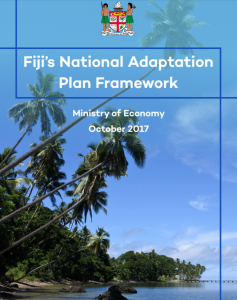
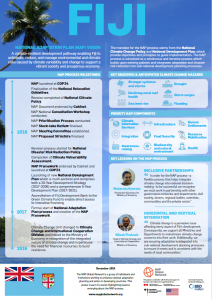
At COP 24 in Katowice, the Fijian Government is launching its first-ever National Adaptation Plan (NAP). With support from the NAP Global Network, the Fijian Government created this NAP document to set out its medium- and long-term ambitions for building Fiji’s resilience to climate change. The NAP provides a clear vision for adaptation and identifies priorities to be addressed in partnership with academic institutions, development partners, and private sector entities over the next five years, and beyond.Clare Church from the NAP Global Network Secretariat spoke with Dr. Adrian Fenton, who has been serving as an embedded advisor to the Fijian Government supporting the Ministry of Economy to develop Fiji’s NAP process. Some answers may have been shortened for clarification and brevity.
Quels sont certains des défis liés au changement climatique qui sont propres aux petits États insulaires en développement (PEID) ?
Adrien Fenton: Adaptation options are constrained in many SIDS due to their small, at times distributed, territories and limited natural resources—especially access to arable land and potable water. For instance, whereas other countries may be able to relocate economic activities and populations further inland, this option is problematic for SIDS like Fiji. The land away from the coastal zones is often mountainous and therefore not suitable for agriculture, and it is more costly to relocate infrastructure. Often, relocation options are limited to other coastal locations, therefore allowing for continued exposure to flood risk and sea-level rise.SIDS and the communities living within them also tend to be dependent on sectors that are reliant on coastal resources, like tourism and fisheries—meaning that there is little scope for economic diversification as a means of managing climate risks. And while, in theory, adaptation options like sea walls and land elevation are possible, given the capital and capacity constraints on many small islands, these options are often beyond their adaptation horizon (the range of adaptation options that are practically feasible given available resources). This is why mitigation efforts and international climate finance are so important at the global level.
Tout en reconnaissant la nécessité d'efforts d'atténuation, les Fidji ont également fait d'importants progrès dans leurs efforts d'adaptation au cours de l'année écoulée. À quelle étape Fidji se trouve-t-elle actuellement dans son processus PNA ?
Selon vous, quelles sont les principales caractéristiques de l'approche des Fidji concernant le processus PNA ?
AF: The NAP process in Fiji builds upon existing development planning processes and associated planning documents and strategies and includes a wide array of different stakeholders. The NAP document identifies 160 climate adaptation measures for the next five years and beyond. These measures were identified through a multi-criteria analysis process and validated through a national consultation workshop attended by government representatives, international development partners, civil society, academia and the private sector.Aside from measures identified in five priority sectors, the government also identified measures to address “systematic priorities.” These are measures identified as essential to addressing adaptation barriers such as insufficient climate awareness and climate information services. It recognizes that vulnerability is not only caused by the impacts of climate change but also due to structural barriers that inhibit adaptation by government, households, communities and businesses from occurring.
L'année dernière, les Fidji ont entrepris un bilan des politiques avant de finaliser leur document PAN. Quelle différence cette analyse a-t-elle apportée au processus PNA des Fidji ?
UN F: The policy stocktake analysis was a vital stage of the NAP process. It contrasted known vulnerabilities to climate change hazards and adaptation barriers against current actions within existing planning documents. Doing so enabled assessment of the extent to which existing activities would be sufficient to address climate change, or whether additional actions would be required, so that these could be included in the NAP process.The policy stocktake was needed to understand the development planning landscape, as well as to address any duplications or inconsistencies in policy documents. Without this step, a NAP process would likely have duplicated actions within other planning documents or, even worse, contradict them.
Quel impact aura un PAN qui plante des arbres quand un autre plan les coupe ?
Policy coherence is vital for national adaptation planning, and a comprehensive policy stocktake analysis is the only way to achieve this.It is also vital for monitoring and evaluation efforts. The Fiji policy stocktake process has resulted in a database that records all measures within the NAP as well as their linkages to other development planning processes. This simplifies reporting processes, which are problematic in SIDS due to resource shortages.
Comment le processus PNA peut-il faciliter l'investissement du secteur privé dans l'adaptation au changement climatique ?
AF: Un PAN solide et complet peut convaincre les entreprises et les investisseurs privés qu'il existe un marché stable dans lequel investir. La planification de l'adaptation ne doit pas dicter aux entités du secteur privé ce qu'elles doivent faire – elle doit leur fournir les ressources nécessaires dont elles ont besoin pour identifier, filtrer, réduire et gérer les risques environnementaux et climatiques.
Sur la base de votre expérience du processus PNA des Fidji jusqu'à présent, quelles sont les leçons les plus importantes que vous aimeriez partager avec les personnes travaillant sur le processus PNA dans d'autres pays ?
Toutes les opinions exprimées dans ce billet de blog sont celles de l'auteur et ne reflètent pas nécessairement les politiques ou les opinions du Réseau mondial NAP, de ses bailleurs de fonds ou des participants au Réseau.Trouver plus de ressources sur le processus PNA des Fidji ici.